
Predestination vs Free Will
By Sam
A biblical examination of predestination and free will, showing how God's foreknowledge and human choice work together in salvation.
I’ve had a lot of questions in the past regarding the conversation of free will versus predestination. I wanted to spend a couple minutes unpacking this in this article. You won’t have to wait till the end to see which side of the fence I fall on. I think it’s important as believers that we read this, and we understand both sides. However, we must make it very clear that this is not a hill worth dying on. This is not a subject worth losing friendships over. This is not something that should cause a rift in a body of believers. First and foremost, our goal should be that of preaching Jesus Christ. Jesus coming, dying for our sins, and rising again. We have the great commission to fulfill. I’m afraid that many times, Christians get too caught up majoring in the minor. We don’t focus on the actual call of Christ because we’re too busy arguing over things that simply don’t matter as much. We are to witness to others about the good news of Christ and the coming judgement. We are to seek each day to live more and more like Jesus. When I stand before God one day, I want Him to see how I stood and proclaimed his name to others. I want Him to see how I was a friend to the friendless, how I was an encouragement to the downtrodden, and how I stood up to the wickedness in the world around me. I want him to see how I spoke the name of Jesus and glorified him in the lives of both those who believed and who didn’t believe.
I don’t want him to look back over my life and see where I argued incessantly with brothers and sisters in Christ about a difference of opinion on a few passages in God’s word. I don’t want him to see where I spent my time arguing over semantics. I don’t want him to see where I wasted opportunities and intellect that he had given me to try to prove a point that really has no influence or impact on the great commission I was called to fulfill. I hope the same can be said for you.
Let’s begin.
As we should with any Bible passage, for each verse, we’re going to get the context, and then we’re going to explain the meaning.
Predestination Verses
These passages emphasize God’s foreknowledge, election, and predestining of believers.
Romans 8:29-30: “For those whom he foreknew he also predestined to be conformed to the image of his Son… And those whom he predestined he also called.”
Paul is most likely drawing on Old Testament language that describes Yahweh’s choice of Israel as His covenant people. In Genesis 18:19, Yahweh uses the Hebrew word for “know” to indicate His choice of Abraham. You can see this same idea in Amos 3:2 and Jeremiah 1:5.
The Greek word used here, proginōskō, means “to know in advance”. Of course God will know in advance who will accept Him and who won’t! He’s omnipotent. He knows it all because he exists outside of our reference of time.
Think about it like you’re on YouTube watching a rerun of Super Bowl 49. Boom. You’re officially outside of the reference of time for Super Bowl 49. Tom Brady threw the winning touchdown in that super bowl. The New England Patriots defeated the Seattle Seahawks 28-24. With 2:02 left, Brady connected with Danny Amendola on a 4-yard touchdown pass, giving New England a 28-24 lead that eventually allowed them to win the game.
Having watched the full game, both you and I know that Tom Brady was going to throw the winning touchdown. Did we force him to do it? Or did he make the choice of his own free will to throw the ball? Duh. He made a choice. Apart from you. Apart from me. Apart from his teammates or his coach. He decided to let the pigskin soar through the air. Just because we know doesn’t mean we somehow forced it to happen.
This is so simple to understand, but somehow we think when we’re talking about God it is different. It isn’t. Don’t wax philosophical or theological. Don’t stick your head in some commentary or read a huge masters level seminary essay. All of that would be completely unnecessary. Just break it down to 1st principles and you can see it easily.
Just because God knows in advance (because He is outside our reference of time) who will choose Him and who won’t doesn’t mean he forces or predestines some for heaven and some for hell. That’s not fitting of the character of God. In fact, if that was to be true, it would go against His character. It would make Him a liar. These are not my words. This is in the Bible.
2 Peter 3:9 The Lord is not slack concerning his promise, as some men count slackness; but is longsuffering to us-ward, not willing that any should perish, but that all should come to repentance
He wants all to come to repentance. So he’s not going to force anyone into a state where they cannot have repentance. He isn’t gonna predestinate them for damnation. Everyone gets a free will choice.
Glad we got that settled. Onto the next verse.
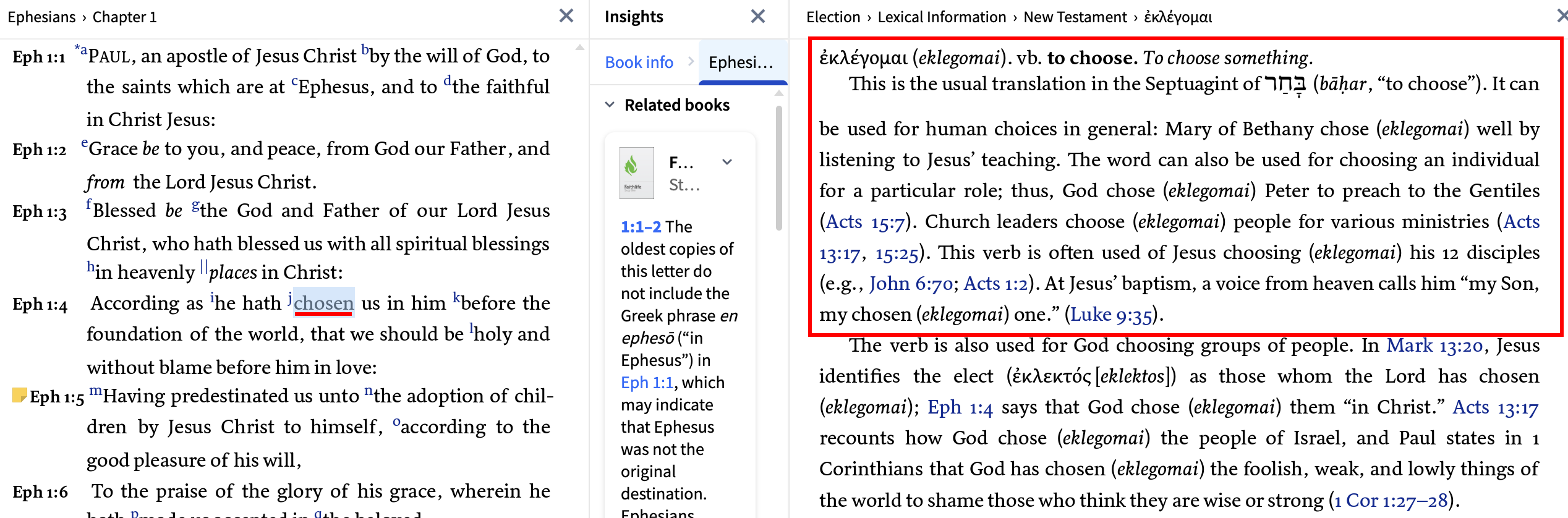
Ephesians 1:4-5, 11: God chose us in him before the foundation of the world… he predestined us for adoption… having been predestined according to the purpose of him who works all things.
 Ephesians 1:4-5, 11 commentary
 God is not choosing who will be saved and who will go to hell in this verse. God chooses the purposes that each of us would fulfill in this life. Jeremiah 1:5 says that he knew each of us before we were in the womb. So, because God knows and cares for you intimately, he has chosen the best possible path for your life. A life that would be holy and without blame before Him. If you follow His will freely , following his chosen path, you will be blessed beyond measure and the God will be glorified through you. That is not to say your life will be free from heartaches and disappointments. But, through all the ups and downs, if we submit God’s chosen plan for us, in the end, we will have lived a life worthy of “well done good and faithful servant”. We can also freely chose to reject God’s chosen plan. We can choose to live a life of our own accord and volition. Time and time again we see the calamity that befalls those which do so.
Notice the : on the end of Ephesians 1:4. A colon (:) signals that what follows explains, illustrates, or elaborates on what precedes it. This tells us that Ephesians 1:5 is a CONTINUATION of the thought in verse 4. We’re still talking about that choice. The focus of verse 5 is Jesus. God is elaborating on the plan that He has given us the choice to follow. We have a choice to follow God’s plan to be holy before Him. Part of the plan that God has chosen would be that we would be children of His. He sent Jesus to serve as a sacrifice and atonement for our sin so that this plan could be feasible. That adoption had to come through the sacrifice of Jesus. God predestined that Jesus would come and die, so that we might have to choice to repent and believe.
Remember… 2 Peter 3:9. God’s perfect plan for each person here on earth would be that they come to repentance. Because of free will, not all will follow God’s perfect plan, but that still doesn’t negate it. John 14:6 tells us that only Jesus Christ is the only way, truth, and life. Once again… God’s will was that Jesus would come and die, so that we, defiled with sin, would still have an opportunity to come to repentance and reconciliation with Him.
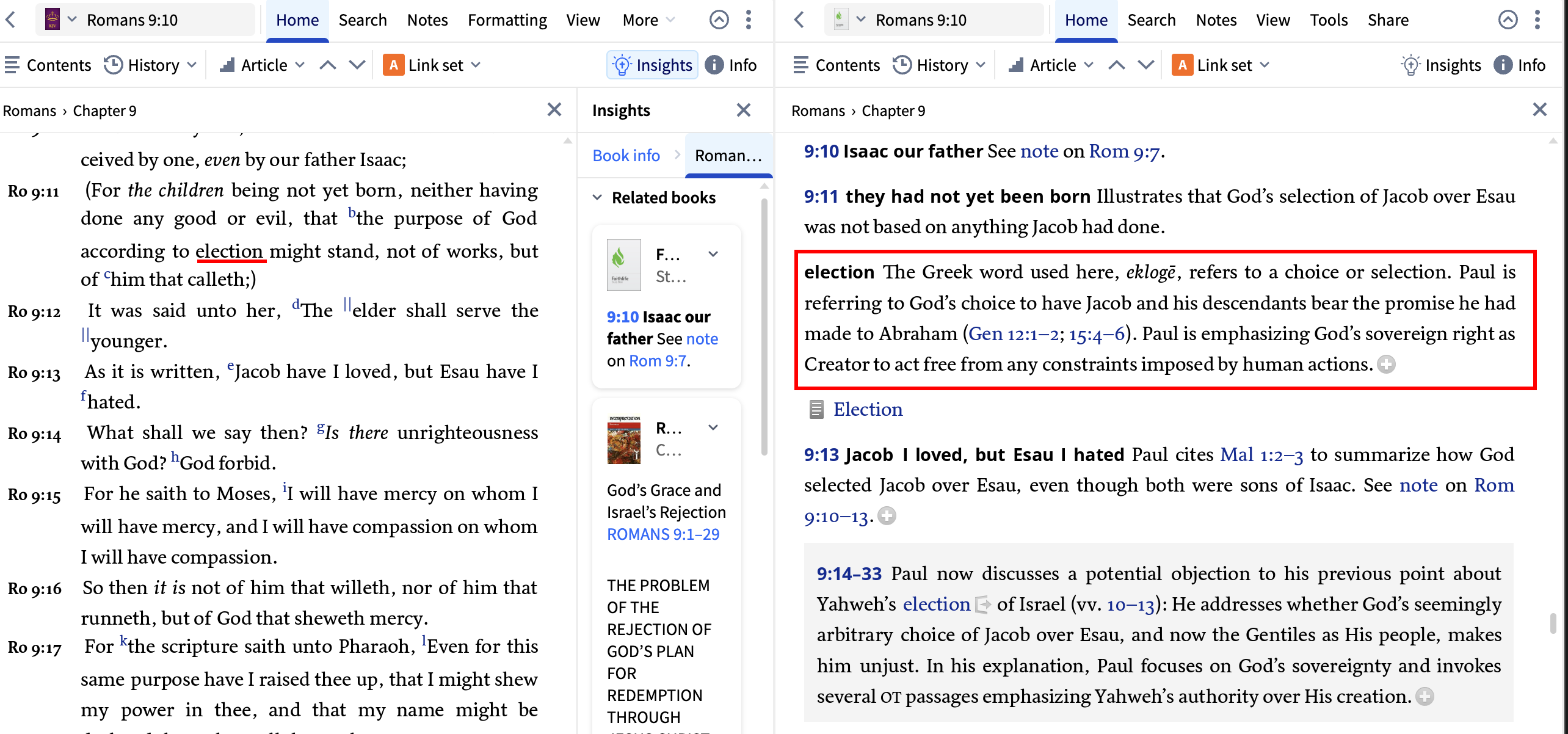
Romans 9:10-16 And not only this; but when Rebecca also had conceived by one, even by our father Isaac; 11 (For the children being not yet born, neither having done any good or evil, that the purpose of God according to election might stand, not of works, but of him that calleth;) 12 It was said unto her, The elder shall serve the younger. 13 As it is written, Jacob have I loved, but Esau have I hated. 14 What shall we say then? Is there unrighteousness with God? God forbid. 15 For he saith to Moses, I will have mercy on whom I will have mercy, and I will have compassion on whom I will have compassion. 16 So then it is not of him that willeth, nor of him that runneth, but of God that sheweth mercy.
 Romans 9:10-16 commentary
 The election speaks of God’s choice to have Jacob (the younger) bear the promise of Abraham, rather than Esau (the older). In this culture, the oldest son lead the lineage forward. He was the patriarch. He received a double portion of the inheritance. He generally had more respect and more responsibility.
God broke free of the human tradition and chose the younger son. He didn’t explicitly choose Jacob to be saved and Esau to be damned. He simply chose to continue the lineage of Israel through the younger son. He stood outside of time, saw the choices that Esau would freely make (to despise his birthright (Genesis 25:34), to marry pagan women (Genesis 26:34), etc) and he decided to work through Jacob instead.
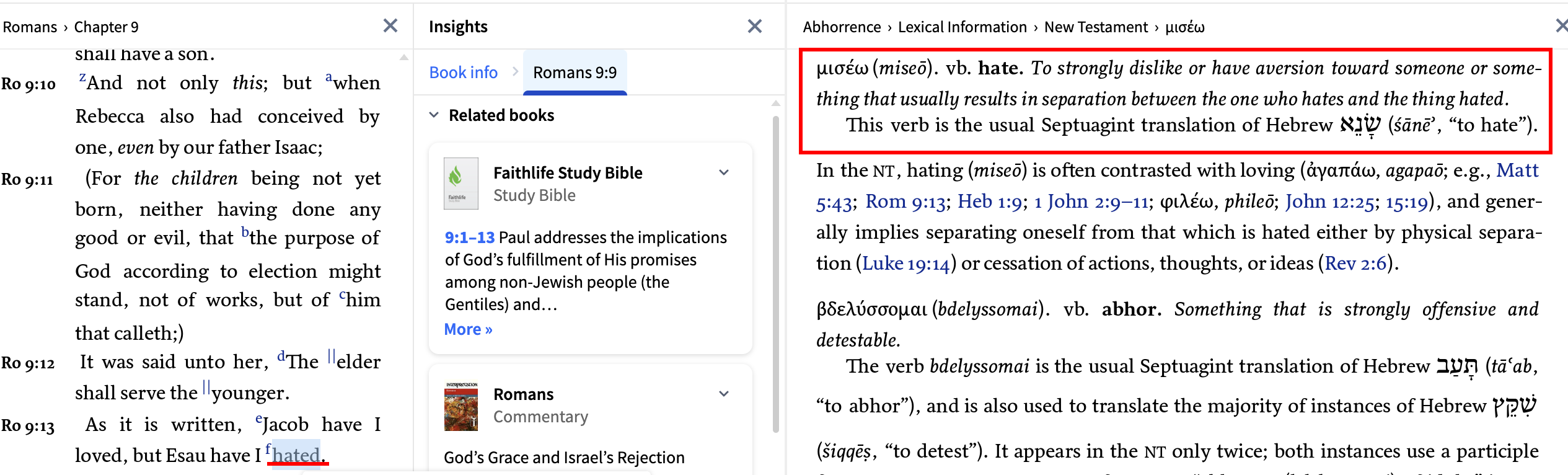
In verse 13, the word hated doesn’t mean that God hated Esau. Think critically. 2 Peter 3:9. How can a loving God offer repentance and salvation and eternal union to people He hates? Why would he adopt those he personally reviles to be children of His? He wouldn’t! He doesn’t! And the Bible clearly says he offers repentance to ALL (which would include those he would supposedly hate)
God didn’t hate Hitler, or Stalin, or Mao, or Pharaoh, or Nero, or any other villain you can think of from history. He doesn’t hate the rapists, pedophiles, murderers, and adulterers. HE HATES THE SIN IN THEIR LIVES. Not the people themselves. THE SIN. As humans, with our finite brains and minuscule frames of reference, we find it unbelievably hard to detach the person from their actions. Fortunately for us all, God can and does. As Jesus hung on a cross, pinned by 7 inch nails drove into his palms and feet, beaten beyond recognition, blood and sweat running down his naked body, what did he say? What did he say to God regarding his mockers and his torturers? Luke 23:34. Forgive them for they know not what they do.
- God offered repentance and salvation to the men who murdered his only son.
- The people who stripped him of his clothes.
- The people who pushed a crown of thorns so forcefully onto his brow that he couldn’t hardly see through the rivulets of blood streaming over his eyelids.
- The people who laughed and jeered at him along the uphill road to Golgotha as he fell under the weight of the 125 lb crossbeam, pinning the splintery wood against the degloved flesh of his back.
God didn’t hate these people. He forgave them. To truly forgive, you can’t harbor hate in your heart. By Jesus (and by extension God) forgiving these people, we can see that we don’t serve a God who hates anyone. He hates the sin. He won’t tolerate the sin. He will righteously judge it at the appropriate time. But he loves the person. He desires that they would follow the plan he put in place through the sacrifice of Jesus and come to a saving knowledge of Him. God didn’t hate Esau and he didn’t predestine him for damnation.
 Romans 9 commentary continued
 Because of the actions Esau chose to take (of his own free will) there was incompatibility between the direction He decided to take his life and the way God wanted to take it. God knew this, so the separation naturally developed.
John 6:44: No one can come to me unless the Father who sent me draws him.
Just like today, people tried to find ways back then to get salvation without dying to self. Jesus was saying no one was going to get that salvation any other way than through the drawing of the Father. Jesus was talking to a group of Jews when he said that. Jews who were consumed with the letter of the law. These people thought that the law could save them. The law was never meant to save us. It was meant to show us our need for a savior.
It’s like waking up in the morning and looking in the mirror. The mirror can show me that my hair is a rat’s nest. However, I can’t then take the mirror off the wall and use it to brush my hair. I need a hairbrush for that! The mirror just shows me the problem. It can’t fix it.
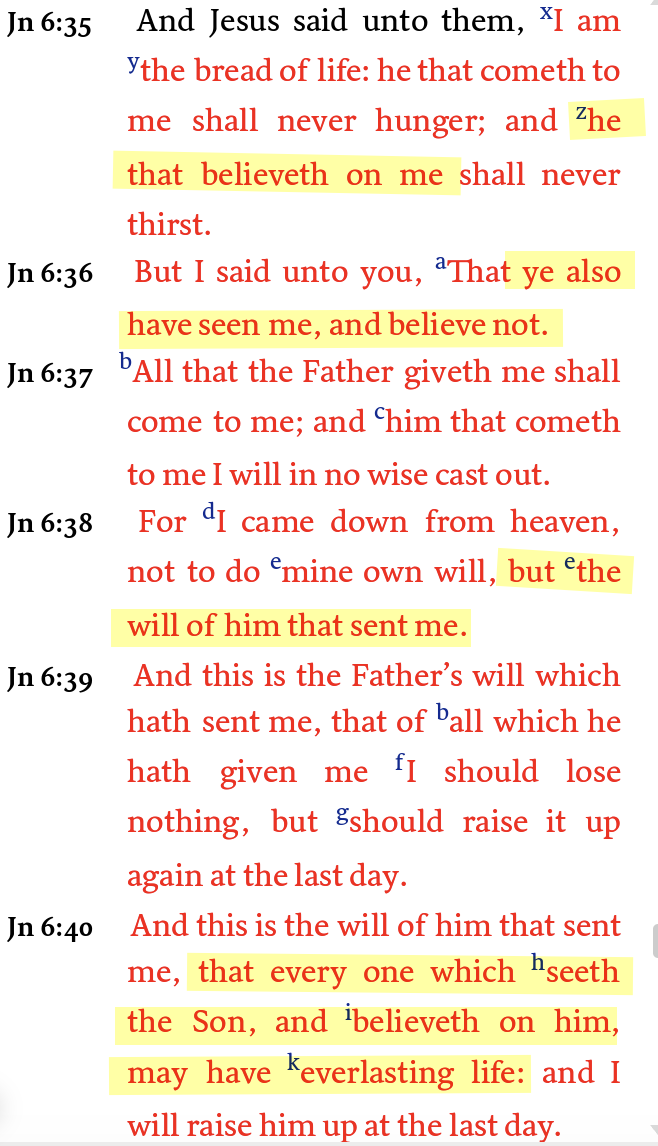
In John 6, the Jews have asked Jesus for signs (verse 30) and bread (verse 34). They were temporally minded. They wanted something visible and external, like the law. They didn’t want to get to the heart of the issue, which was their own hearts. They were trying to use the mirror to brush their teeth. And what does Jesus say?
 John 6 commentary
 - John 6:35 says he that believeth on me . He doesn’t say God picks and chooses. He says some have belief and some don’t.
- John 6:36 further proves the free will choice. They saw him and they believed not . God knew they wouldn’t, but he didn’t force that upon them
- John 6:38 says that Jesus makes the choice not to do his own will, but rather the Will of God. Jesus was fully man and fully God. He was in all things tempted as we are, yet without sin (Hebrews 4:15). So if Jesus was fully man, and he made the choice to follow God’s perfect will for his life, rather than reject it, we can make that choice as well.
- John 6:40 says everyone . Everyone can make the choice to believe on him and have everlasting life, not just a select few.
So, of course, when we read John 6:44 in context of these earlier verses, we can understand why that verse is not saying that God will only draw a few people. It is saying that God must be the one who does the drawing because He is the only one that can save us, not the law or any other external factor.
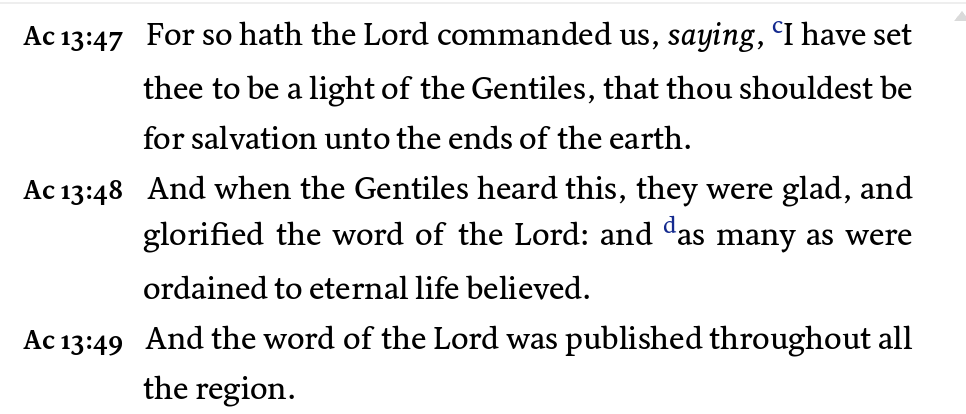
Acts 13:48: And as many as were appointed to eternal life believed.
 Acts 13:48 commentary
 When Luke wrote this, he was talking about how the gospel had reached the Gentiles in this region according to God’s plan. Verse 47 is Paul and Barnabas talking of how the Lord had commanded them to be a light to the Gentiles. Despite all the opposition, God’s intended purpose for the gospel to be brought to the Gentiles had come to pass. The Gentiles were appointed to eternal life just as the Jews had been. They were given the same chance. The gospel was not just reserved for the select few. It was not just reserved for the Jews. It was not just reserved for a chosen people. It was for everyone.
Another way to look at it… we’ve all been appointed to eternal life. Saved and unsaved alike. Some will live on in hell eternally. Some will live in heaven eternally. But the soul never dies for any of us. We can see in Luke 16 where the rich man lifts up his eyes in hell and sees Abraham and Lazarus afar off. This shows us that he, and unsaved person, still remembers his time on earth. So from that we can surmise both the saved and the unsaved will have an eternal fate to reckon with.
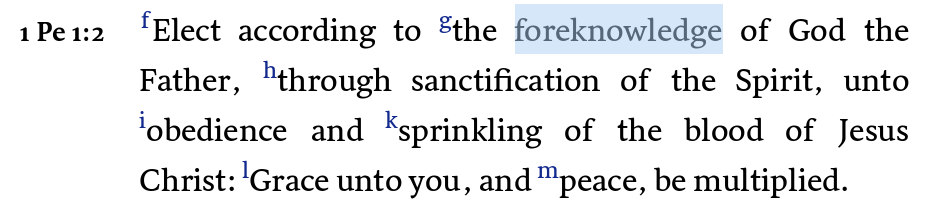
1 Peter 1:1-2 (elect according to foreknowledge)
 1 Peter 1:1-2 commentary
 For the new testament, “The Elect” is the church. It consists of both Jews and Gentiles. In the Old Testament, you can see in Deuteronomy 4:37 or Isaiah 4:54, where it speaks of the nation of Israel being God’s elect. The elect is not a group of people that got handpicked to be saved while God condemned the rest to hell. It is simply those that He knew would come to saving knowledge of him and make that free will choice. Hence the word “foreknowledge”. He KNEW it be-FORE it happened because He exists outside of time and is fully omniscient. This doesn’t mean he intentionally caused it. For God to intentionally cause it would mean He intentionally caused his creation to go to hell, which doesn’t make any sense and goes completely against the character of God.
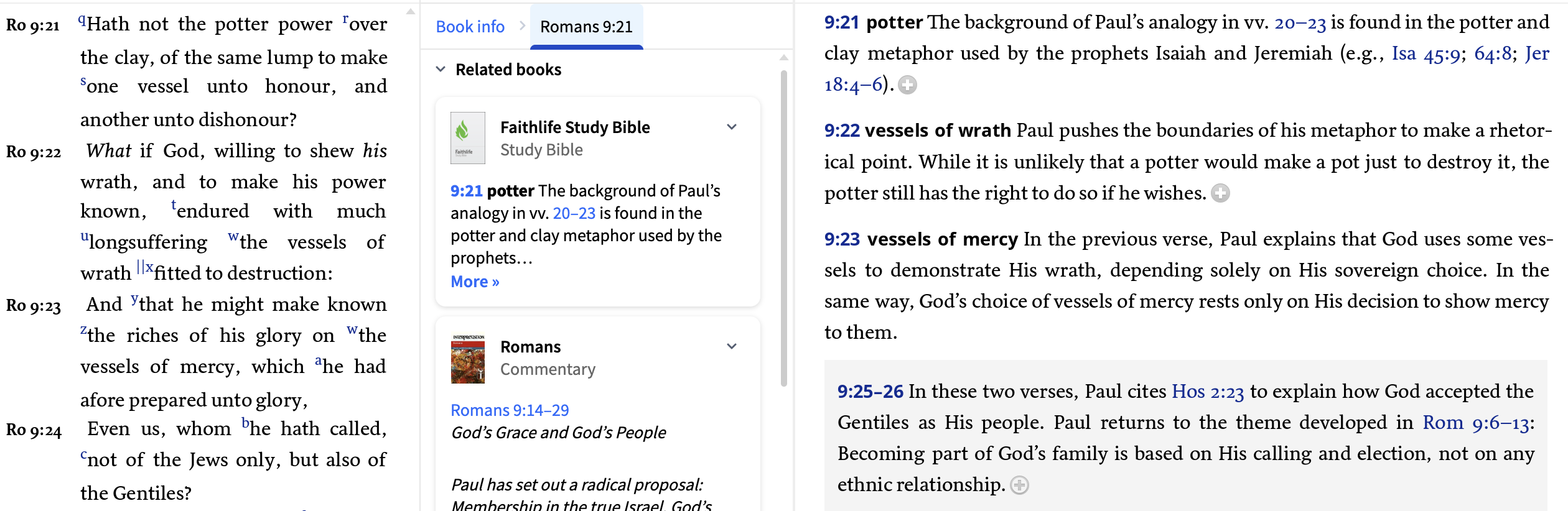
Romans 9:21-23 (potter and clay).
 Romans 9:21-23 commentary
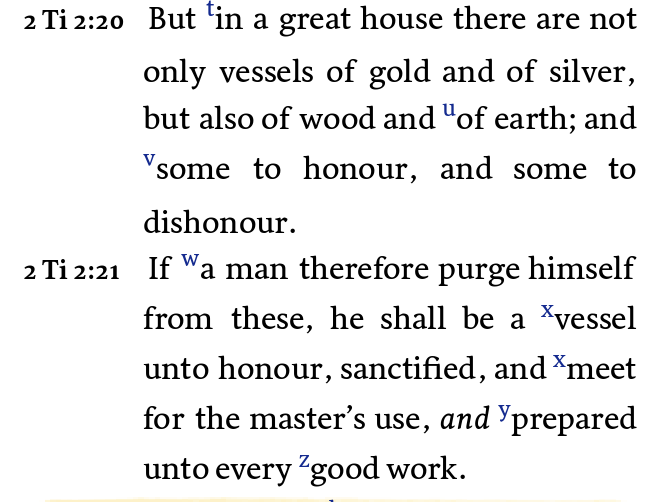
 The potter clay analogy is used often times to show that the clay can obey God. It can turn to God, and God uses it to his glory. Just look at what Paul writes in 2 Timothy 2
 2 Timothy 2 commentary
 2 Timothy 2 shows us that the clay can respond positively to its maker and become a vessel unto honor.
For more context, on the potter/clay analogy use the passage the Paul is citing Jeremiah 18:1-11. The passage clearly states that God uses vessels for dishonor if they disobey him. And he uses vessels for honor if they obey him. Paul isn’t saying he creates vessels for honor or dishonor. He is saying, God can use even vessels of dishonor to bring about his ends, and who are we to talk back to God. So God’s choice is NOT who will be a vessel of dishonor/honor. God’s choice which no man can question is HOW he will use vessels of honor and dishonor.
Nowhere does Romans 9 say that God it is God’s choice who will be a vessel that rejects him. It says that God can use any vessel for his own purposes, even the vessels that reject him. This is exactly what he did with the Jews. Remember… the Jews were worshipers of their father the devil. They rejected Yahweh. And God used them and their rejection as vessels of dishonor to crucify his son.
To read this to mean predestination is the negative inference fallacy. Predestination people are assuming that since God makes a choice, man cannot make another choice. That is like saying, “Since I went to the grocery store today, I didn’t also go to the gym.” You can’t make the negative inference that man cannot choose God because God has chosen man.
Those who believe predestination are presupposing that because God has elected some to salvation with an irresistible grace, from before the foundations of the world then his choice HAS TO BE for salvation in Romans 9:11-21. But the text never says that God has elected people for salvation. All it says is that he elected some before they did anything good or bad. What did he elect them to? Service. For instance, regarding the Jews, He elected them to be the means by which he would bless the entire world thus fulfilling his covenant with Abraham in Genesis 12:2-3. All the word “election” means is that God chose, and he chooses all kinds of different things. He chose Jeremiah to be a prophet. He chose Paul to be his Apostle. He chose that those who are faithful will be saved. He chose Abraham and his descendants to be a blessing to the entire world, and He chose to bless and punish them as his children. So when they rejected him, he still chose/elected to use them anyways. He chose to use vessels of dishonor, the Jews, to bring about the Crucifixion of Christ.
God’s purpose in election was to save the entire world through the crucifixion of Christ. He called Israel to be the means by which that would happen. Again… He did it before they did anything good or bad. They can’t say “why have you made me like this?” because he is their maker. He is the potter and he has the right to make them into whatever vessel he wants for whatever purpose he wants.
So when they choose to reject him, per Jeremiah 18, he can use them to crucify Christ. This is a perfectly reasonable interpretation that maintains the holiness of God. Those who errantly believe in predestination cannot maintain the holiness of God through their interpretation . Under their interpretation, God has made people to sin. Somehow, a holy God has intended that people sin. So he isn’t actually set apart from sin.
A free-will interpretation elevates God while a predestination interpretation lowers him to the level of a sinner and makes Him weak. Under the predestination interpretation, God HAS TO make people sin. He is unable to bring about his ends unless he literally authors evil. Unless he condemns people to hell. A free-will interpretation is that God can bring about whatever end he wants even though people freely sin. Our God is big enough that he can use whatever vessel he wants, for whatever purpose he wants, because he is simply that great.
Free Will Verses
These highlight human choice, accountability, and God’s appeals to decide.
I’m not going to go as in depth on the verses below because I feel that they’re pretty self-explanatory, and we all understand what they mean. Still they’re worth mentioning.
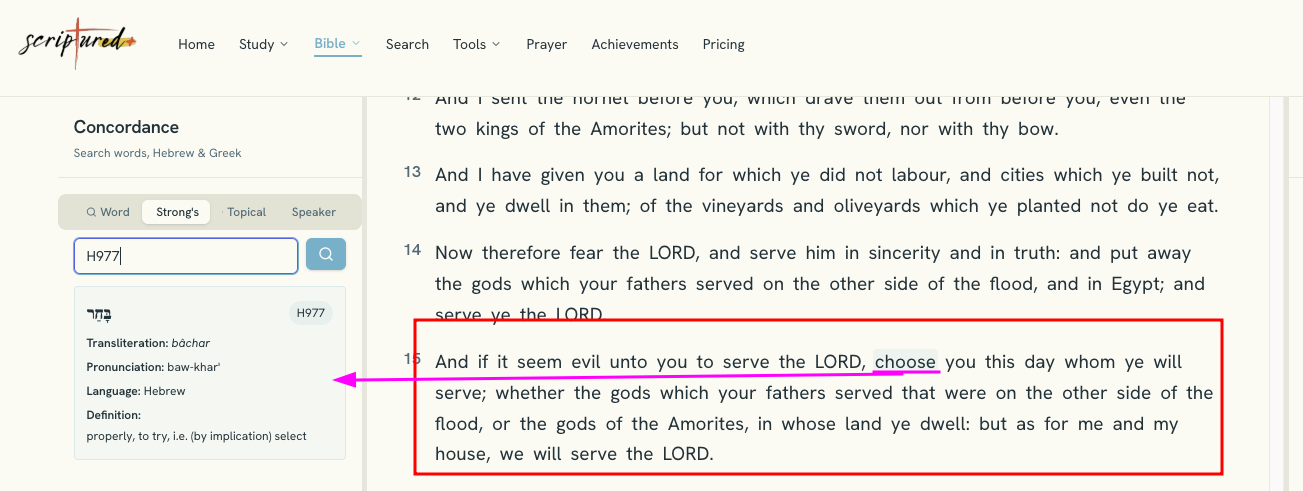
- Joshua 24:15: Choose this day whom you will serve… But as for me and my house, we will serve the Lord.
 Joshua 24:15
 We have a free choice to make in who we choose to serve. We can choose to serve God, or we can choose to serve the false gods of this world, and ultimately serve Satan. To not make the choice for God is to make the choice to serve Satan. There is no such thing as sitting on the fence when it comes to salvation. You have to make the choice to believe or not to believe, but the choice is entirely yours, and it will be until the day you take your last breath.
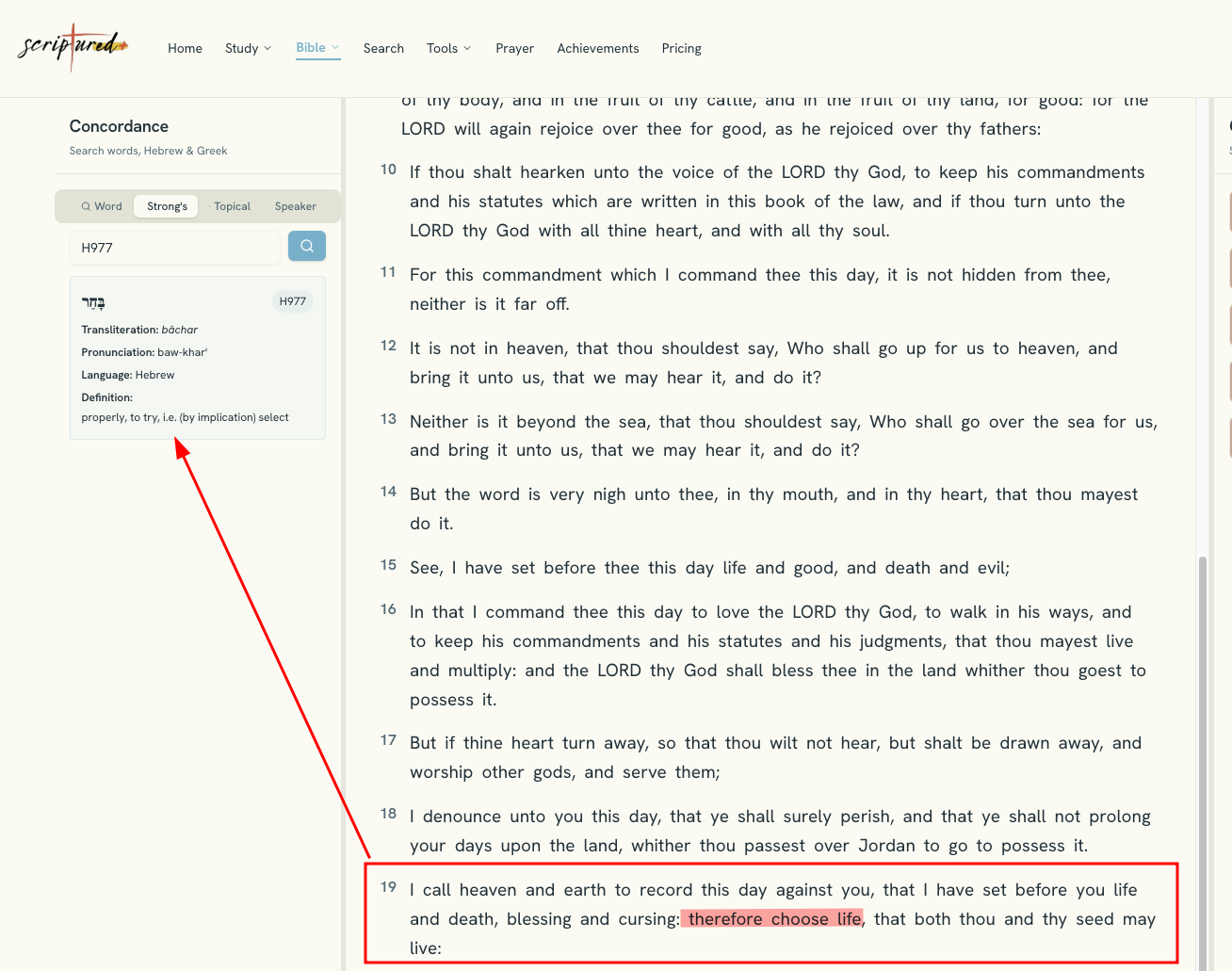
- Deuteronomy 30:19: I have set before you life and death, blessing and curse. Therefore choose life.
 Deuteronomy 30:19
 It’s the same word for choose here. We have to make the choice to choose life that we may live. God says that he sets before us life and death. He sets before us blessing and cursing, but we make choice.
I can choose to make choices outside of God’s will for my life and thus end my life in a cursed and wretched state. OR… I can choose to make choices in my life that honor and glorify God and thus be blessed through that. Not blessed simply in the physical sense of wealth and fame and comfort, but be blessed in knowing that I have made the choice for God of my own free-will. I have chosen to live a life that is honoring and serving to him.
- Revelation 3:20: Behold, I stand at the door and knock. If anyone hears my voice and opens the door.
 Revelation 3:20
 When the Bible says anyone, it truly does mean anyone. Jesus has not decided there are certain people he will have a relationship with and certain people he won’t. He has accepted that, but he didn’t make a command decision to reject some and accept others. He says he stands at the door and knocks (fun fact… Matthew 7:7 reiterates this same point). And if any man hears his voice and opens the door, then he (Jesus) will come into him. So we see here a promise to always come when man makes the choice to ask.
- John 3:16: For God so loved the world, that he gave his only Son, that whoever believes in him should not perish. (Implies belief is a choice.)
 John 3:16
 Much in the same vein as the last verse, whosoever means whosoever. That doesn’t just mean a select few. God loved the entire world. He didn’t just love parts of it. When he gave his only begotten son to come and die, He meant to offer salvation for all .
God is not willing that any should perish, but that all should come to a saving knowledge of Him (2 Peter 3:9). He wants us all to have everlasting life. So the choice is ours. We have the choice to love, accept, and follow Jesus or to reject the sacrifice that Jesus made.
Below are some honorable mentions.
- Acts 16:31 (believe)
 Acts 16:31
 The Bible says to believe on the Lord Jesus Christ. It doesn’t say, “believe on the Lord Jesus Christ (and hope that he has chosen you too)”. The Bible simply says to believe and you shall be saved.
- Romans 10:9 (confess)
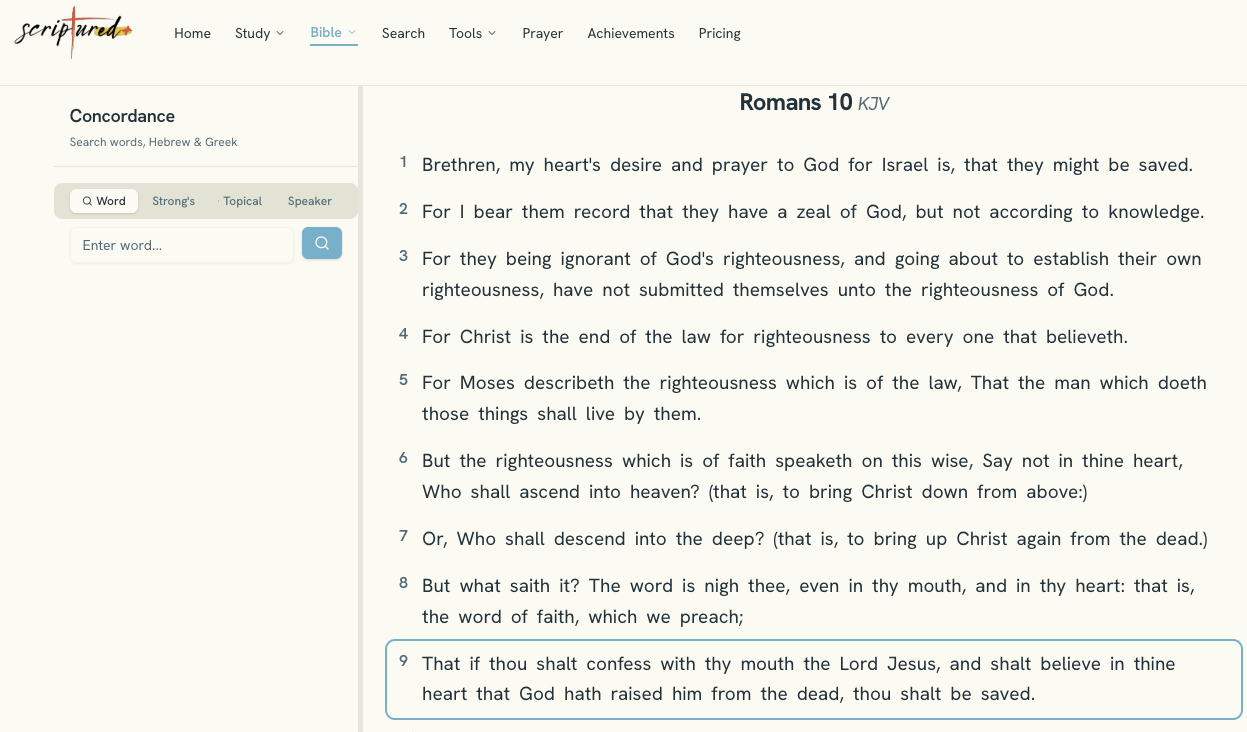 Romans 10:9
 Confession is the key to salvation. It’s not something that some get and some do not. Thou is me and you and anyone else who chooses to confess with their mouths the Lord Jesus and believe in their heart that God raised Him from the dead. When God says they shall be saved, that is a promise.
As a side note… once-saved-always-saved is bad theology . If you believe once-saved-always-saved, then you believe that you effectively lose free-will after you accept Christ. You believe you become a moist robot capable of only following God and being with Him in paradise.
Of course, this isn’t true.
What is true is that no external factor will ever be able to TAKE your salvation from you (Rom 8:38-39). You cannot lose it, but you can forfeit it of your own volition. No one else can take it away from you. No one else can steal it or remove it or nullify it. But till you take your dying breath, God will give you the free-will to eternally reject Him. If you didn’t have that choice (even though there’d probably only be 0.00000000000000000000000000001% chance it would ever faintly cross your mind to carry out), you would effectively be robotic. YOU HAVE TO ALWAYS HAVE THE CHOICE. Why? Because God wants your heart fully. He wants your devotion with no strings attached. He wants it to be your decision. And, if at any point before you die you were to be locked in and that free-will were to be removed, it technically would no longer be your decision. This is common-sense reasoning.
Hebrews 4:6 sums it up
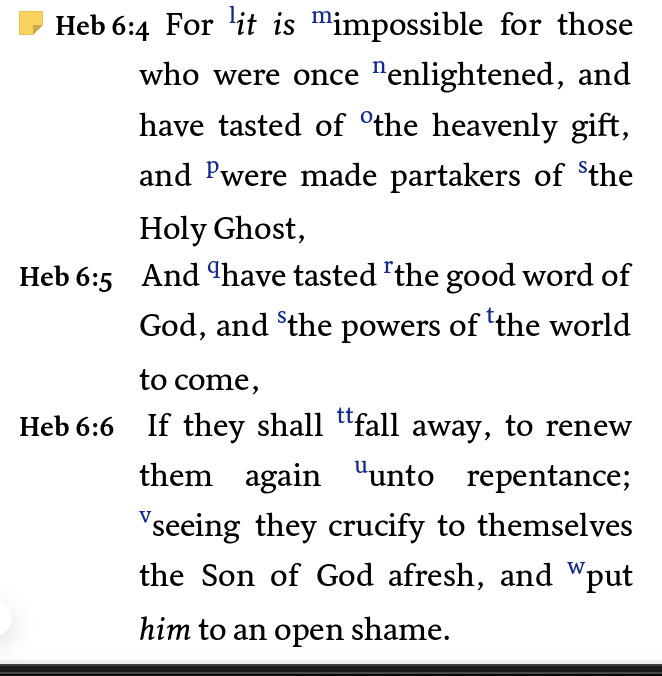 Hebrews 4:6
 If they fall away (aka reject the faith) then they can’t be renewed again (indication they had already been renewed/saved once). The bad news is that if a person falls away in this manner, their mind becomes reprobate, and they will have no desire to be saved ever again (Rom 1:28-32). The good news it that if you still feel that worry in your heart, or that desire to be saved, or if you’re unsure of your salvation, you haven’t fallen away in the context of Heb 6:6. This is where you take your worry back to the Lord. Admit you’re a sinner, admit Jesus died and rose again to save you from those sins, believe on Him and resolve to live a life pleasing to Him. Then have faith that the Lord has saved you and will sustain you.
As we’ve seen looking through the Scripture today… God is a God who has blessed us with free-will.